Your Coach's Week, on Your Own Phone
Last week Coach learned to show a trainer what they booked beside what you logged. This week the same thing arrives on the other side of the link: on your phone, on Train, your coach’s week beside your own. Plus the meals they booked for you, two more chains in Road Food, and a name at the top of the card so you know who sent it.
Your coach’s week, on Train
If someone coaches you, their plan and your log have always been two separate things that never met. Train shows one day at a time, and it will not go past today. So a session booked for Friday was legible on no screen until Friday arrived, and a Wednesday you did train was already behind you by Thursday.
Train now carries a card for the whole week: which days were booked, which you logged, and inside a day, what was asked above what you did.
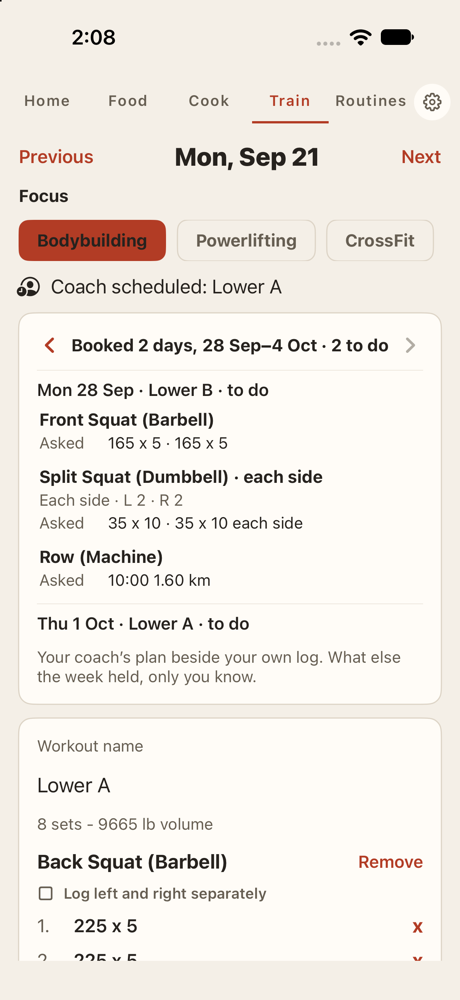
A day still ahead says to do, and shows the work. Not a zero, not a blank,
not an absence. That is the part no other screen could give you: the sets and
reps for a day you cannot scroll to yet. A day behind you reads logged or
not logged, and a day you trained that nobody booked reads not booked, with
what you did on it.
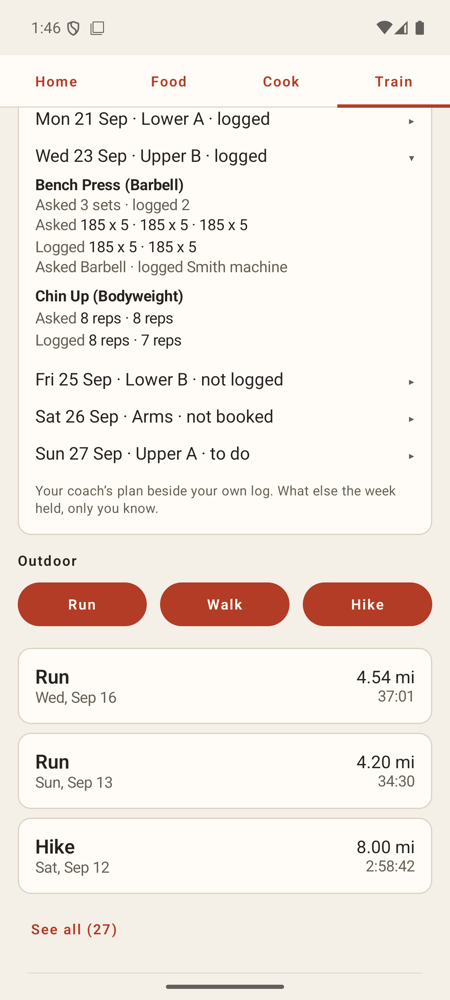
It is a week, Monday to Sunday, rather than a mark on today, for that same
reason: the days you cannot reach are the ones worth seeing mid-week. The arrows
read the week either side. A lift done on another machine is paired and labelled
Asked Barbell · logged Smith machine. Sets are counted, never matched one to
one, because if you did three of four the app cannot say which one you dropped.
You are not being graded. No score, no percentage, no streak, no colour on a
day nothing was logged against, nothing carried from one week to the next. The
words are logged and not logged, the same ones your coach reads, never
“missed” or “skipped”. Under every card:
Your coach’s plan beside your own log. What else the week held, only you know.
A week your coach booked nothing in is no card at all, rather than an empty frame explaining itself. And nothing new travels for any of this: no new key in the link, nothing extra stored, no new permission. The card reads the plan you already accepted against the log already on your phone.
The meals they booked, and nothing about what you ate
A coach can book meals as well as sessions. Those now show on the same card, under the day they were booked for.
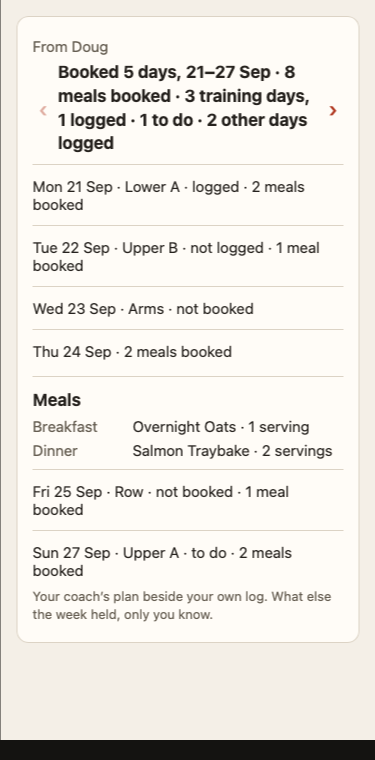
The useful part is the same as for a session: the dish booked for a day you cannot reach. Cook’s plan shows seven days from today and Train shows one, so a dinner booked for next Thursday was readable nowhere until you got there. A week that books only food is now a card where before there was none.
Here is the deliberate absence, and it is the most interesting decision of the week. The card says nothing whatever about what you ate. No tick beside a dish you cooked, no count of the day’s foods, no verdict on a meal slot, no macros next to a booked dinner. Your phone does in fact know when a planned meal was logged, and it is still not printed.
The reason is that a tick on some meal rows and a blank on the rest is a score with the numbers filed off. Nobody reads “Dinner, no tick” as a neutral fact. And you are the one person on earth who already knows what you ate today. Reading your own food log back to you in the third person, under a heading with your coach’s name on it, tells you nothing you did not know and turns a day you ate differently into a mark against you. Your food log is on the Food screen, dated, where it always was.
Your coach’s copy does do the other half. Their Booked card names the foods you stamped with that slot, above a count of the day’s foods, under a note saying it cannot know whether the dish was the one they booked. That is a trainer reading about someone else and needing to be told the limits of it. This is you reading about you.
Booked meals are on the browser version only so far. The phones show booked sessions today and the meals are next.
Signed, and matched to the right session
Two smaller things that both come down to the card telling the truth about where something came from.
The week is signed with your coach’s name. From Dana, or From Dana ·
Doug if two people booked one week, at the top of the card. A plan that carried
no name reads From your coach, exactly as every plan accepted before this
does. The browser has printed it since the card shipped; both phones dropped the
name on the way in and now keep it.
Starting a booked session records which booking it answered. Before, pressing Start on a coach-scheduled workout wrote an ordinary session and nothing remembered the two were related, so a second session you logged that day got folded into the comparison. Now the booking remembers, and the extra session is listed on its own as also logged instead. A routine you start from your own library is never marked: a template is reusable, and starting one must not use up a booking. That one is on Android.
The card, said out loud
Both cards are built from short lines with a · between their clauses. On
screen that is a comma that takes up no vertical space. Through a screen reader
it is either the name of a character or nothing at all, and either way
Mon 28 Sep · Lower A · logged · 1 meal booked arrives as four unrelated
fragments. L 3/3 · R 2/3 arrives as no language whatsoever — on the one line
of the card that says something about your body.
Both cards now compose a spoken version of every line beside the written one.
· becomes a comma, the sign between a weight and its reps becomes “by”,
3/3 becomes “3 of 3”, L and R become “left” and “right”, and
Mon 28 Sep becomes Monday 28 September, so the day row above is read as one
sentence:
Monday 28 September, Lower A, logged, 1 meal booked. Opens this day on Train
It is composed from the same parts the written line is composed from, never by
substituting characters in the finished text — that would have to guess whether
the x in a lift you named yourself is a multiplication sign.
Four smaller things turned up on the way:
- What you were asked to do and what you did are a comparison, and read apart they are two lists of numbers with nothing between them. They are one announcement now, under the lift’s name, which stays a heading so you can still move lift to lift.
- LIFT’s week arrows were
‹and›and nothing else, so their accessible name was a quotation mark. They are “Previous booked week” and “Next booked week”, and an arrow with nowhere to go says so rather than only looking greyed out. - A day row said it could be pressed, but not whether it was open — the card drew that only by whether more lines followed it — or that opening a day Train can show also moves Train there. Both are stated now.
- Coach’s By day / By lift chips showed which was selected in colour alone.
Nothing on screen changed: not a string, not a pixel. And nothing is given
emphasis aloud that it does not have on the page. not logged is as flat
spoken as it is written, because the card counts and does not grade — and that
is either true in both forms or it was never true at all.
Taco Bell and Sheetz
Road Food covers 13 chains now, 19 more items than last week.
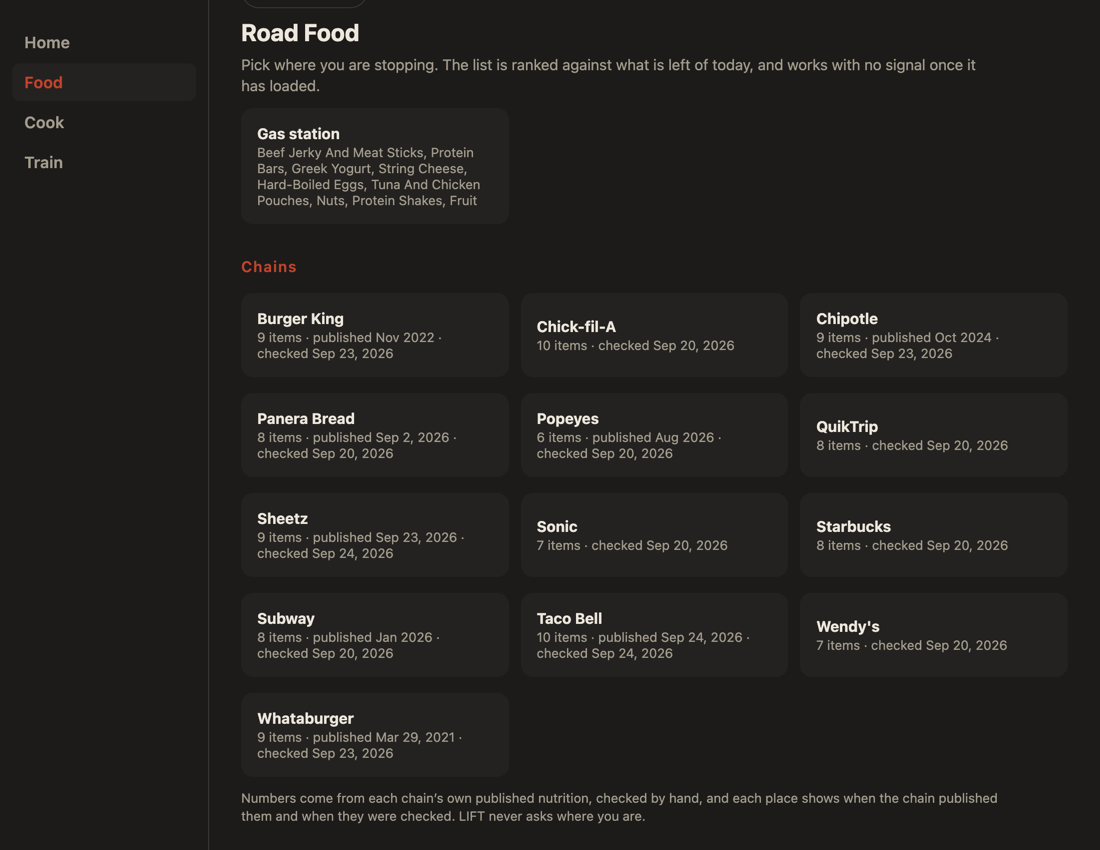
Both of these were on the list of chains left out, for the same reason: they publish their nutrition through a calculator rather than a table. That turned out to be the wrong way to read it. The calculator is embedded in the chain’s own nutrition page, and a chain embedding a grid on its own site is the chain publishing its figures. Looking the same numbers up in somebody’s food database is still out, and always will be.
So the rule now names the difference, and the quarterly checker enforces it. Every run it opens the chain’s own page, confirms the embed is still there, and says so in the report before it reads a single number from it. If a chain drops the embed, the report says so and a person goes and looks.
Some items were left out, for reasons worth knowing. A row that prints < 1 for
sugar publishes neither a number nor a blank, so it stays out until it prints
one, and four rows across the two chains went that way. Sheetz’s grid also has
build-your-own starting points named like finished sandwiches, carrying only the
meat and no roll: logging one of those as a sandwich would under-count a meal by
more than 200 calories. None of them is in the list under a sandwich’s name.
Where to get it
- The browser versions are live now: LIFT and Coach — the week card, the booked meals, the spoken card, and the two new chains.
- LIFT for Android 1.16 and Coach for Android 1.13 are on their install pages (LIFT, Coach). Between them they carry everything above: the week card and the meals booked on it, the coach’s name, the booking record, the spoken card on both sides of the link, and Taco Bell and Sheetz.
- iPhone and iPad builds carry all of that bar the booking record, which a log keeping one session a day has no use for; they are not on the App Store yet.